Enterprise Infrastructure Readiness Guide: Planning Networks, Cabling, Security and Site Infrastructure Before Deployment
Technology projects are often scoped around the equipment being purchased. The more difficult question is whether the environment receiving that equipment is actually ready. This guide examines the physical, network, security and operational conditions organisations should understand before major ICT and security deployment begins.
By Devjee International14 min read
Executive summary
Major technology projects are usually described in terms of the system being introduced. Organisations discuss new wireless networks, CCTV platforms, access-control systems, cloud services, switches, fibre links or connected devices. Budgets are prepared around hardware and software, suppliers are appointed and deployment dates are agreed.
The condition of the environment receiving that technology can receive far less attention.
That is where many avoidable project problems begin.
A new system may be technically appropriate while the underlying cabling is poorly documented. Network switches may have enough ports but insufficient Power over Ethernet capacity. Wireless access points may be specified before anyone confirms the actual radio environment. CCTV locations may appear correct on drawings but conflict with the finished building. Communications rooms may lack suitable power, cooling or rack capacity. Equipment may be delivered, but to a different location from the one where installation is taking place.
Each issue is manageable when discovered early. The difficulty comes when these conditions are discovered after technicians, equipment and project deadlines are already involved.
Infrastructure readiness is therefore not a preliminary administrative task. It is a way of reducing uncertainty before deployment begins.
This white paper sets out a practical approach to understanding enterprise infrastructure before major technology change. It considers the network, structured cabling, wireless environment, security systems, power, equipment spaces, resilience, site conditions, documentation and the operational model that will remain after commissioning.
The objective is not to recommend replacing everything.
A good readiness process should identify what is already suitable, what is likely to become a constraint and what needs to be addressed before investment is committed to the next layer of technology.
Start with the environment, not the equipment
Technology projects naturally attract attention to what is new. Procurement teams compare products, technical teams evaluate specifications and project plans are built around installation milestones. This can create an assumption that the new equipment is the project.
In reality, the project begins with the environment into which that equipment will be introduced.
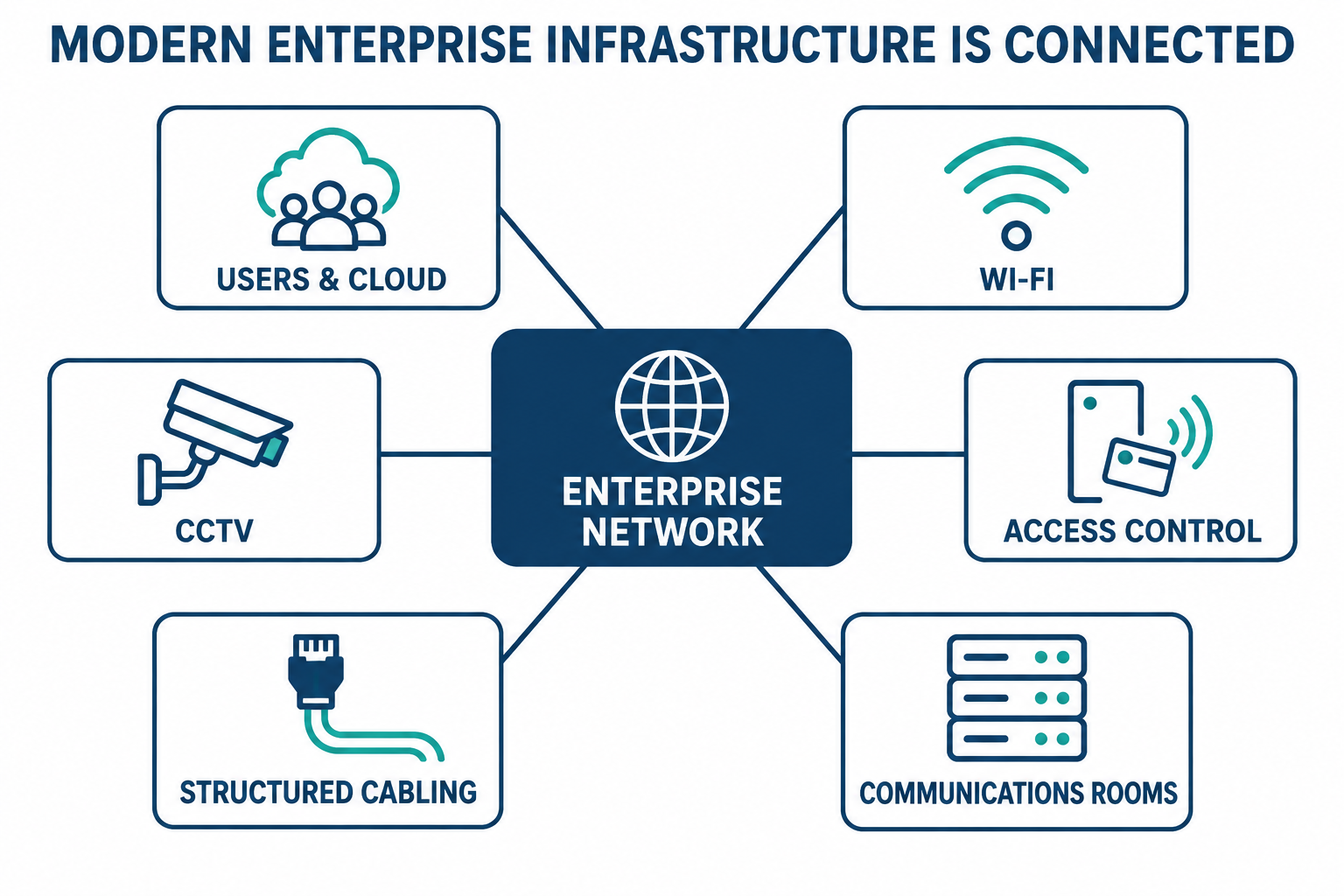
A business installing a new CCTV system is not working only with cameras and recorders. It is working with cable pathways, network switches, uplinks, storage, power, communications rooms and physical mounting locations. An access-control deployment interacts with doors, locks, emergency release, network connectivity, power and building systems. A wireless upgrade depends on the building itself, user density, interference, cabling and switch capacity.
The same principle applies to cloud adoption. Applications may move away from the premises, but users still need reliable local networks, wireless connectivity and external links to reach those services.
Infrastructure readiness is therefore the discipline of understanding those dependencies before they become project problems.
It should answer three basic questions.
What is already in place?
What is the proposed technology expected to require?
Where is the gap between the two?
Those questions are simple. Answering them properly often requires a combination of documentation review, physical inspection, testing and conversations with the people who operate the environment.
Establish what is actually installed
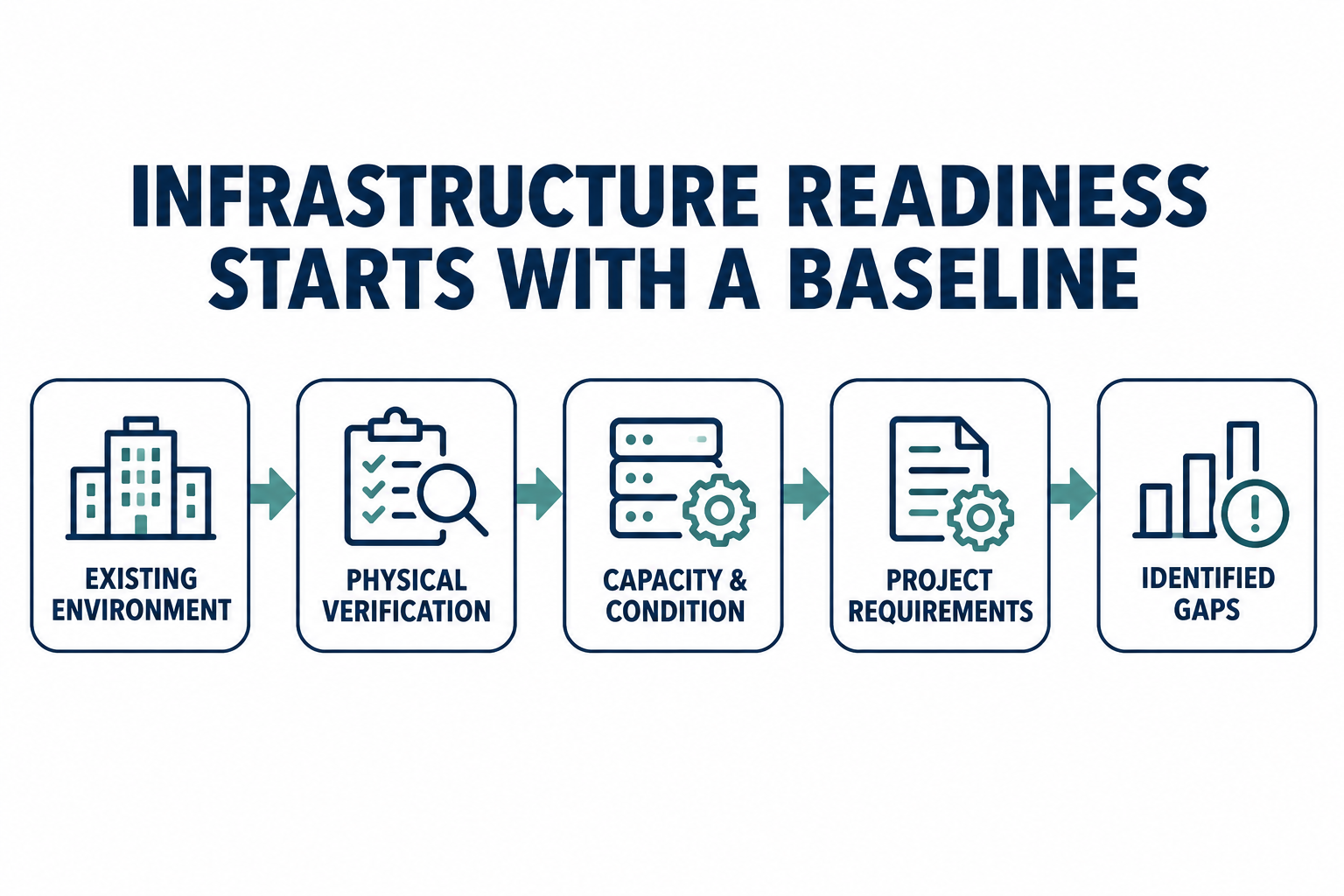
The first step is to establish a reliable baseline.
Existing drawings, equipment lists and network diagrams are useful, but infrastructure changes constantly. A switch is replaced during a fault. New cameras are installed during an expansion. Fibre is added between buildings. A temporary connection becomes permanent. An office moves and additional network points are introduced.
After several years, the records and the physical environment may no longer match.
A readiness review should therefore verify important infrastructure rather than relying entirely on historical documentation.
That may include checking network racks, switches, routers, firewalls, wireless access points, fibre termination, patch panels, cabling, internet services, power arrangements and the systems already sharing the network.
The purpose is not to inventory every cable for its own sake. The objective is to understand enough of the environment to plan accurately.
For example, a project team preparing a CCTV expansion needs to know whether the access switches have sufficient available ports and power capacity. A wireless upgrade requires an understanding of the cabling serving existing access points and the capabilities of the switches behind them. A new building connection may depend on spare fibre capacity that exists on paper but is already in use.
Physical validation turns assumptions into information.
Treat structured cabling as long-term infrastructure
Active technology changes quickly. Structured cabling usually does not.
A business may replace its switches, wireless access points and security equipment several times while retaining much of the same copper and fibre infrastructure.
That makes cabling one of the most important long-term decisions in the technology environment.
A readiness assessment should consider what categories of copper cabling are installed, where fibre is used, how backbone routes are designed, whether patch panels and outlets are labelled consistently and whether existing links are still suitable for the performance expected from the new deployment.
Installation quality matters as much as specification. Poor termination, damaged cables, excessive bend radius, inappropriate routing and undocumented extensions can all create problems that only appear under increased load or after new equipment is introduced.
Where existing cabling is going to remain in service, testing may be more valuable than replacement based purely on age.
The correct question is not simply whether the cabling is old. It is whether it is suitable for the requirement.
Fibre deserves similar consideration. Organisations should understand where fibre routes exist, how many cores are in use, where termination points are located and whether backbone capacity is sufficient for planned growth.
This becomes particularly important where buildings, warehouses or operational areas depend on only one physical path.
Understand capacity across the entire network
Network capacity is often discussed in terms of internet speed.
That is only part of the picture.
Traffic moves through multiple layers before it reaches an external service. Access switches, uplinks, fibre backbones, core switching, wireless infrastructure and WAN connectivity can all become bottlenecks.
A fast internet connection does not correct congestion on an overloaded switch uplink.
The traffic itself also matters.
User applications often create variable demand. CCTV can generate continuous streams. Voice systems are sensitive to delay and packet loss. Backup processes can consume significant bandwidth during scheduled periods. Wireless environments may concentrate many devices behind a relatively small number of access points.
Power over Ethernet adds another capacity dimension.
A switch may appear to have enough ports available while having insufficient remaining power budget for additional cameras, access points or other devices. This is particularly relevant when older devices are being replaced by more capable equipment with higher power requirements.
Capacity planning therefore needs to consider data, power and growth together.
The objective is not to build an oversized network for every possible future requirement. It is to avoid designing new systems around infrastructure that is already operating close to its practical limits.
Wireless infrastructure requires physical validation
Wireless networking is particularly sensitive to the environment.
Floor plans can suggest where access points should be installed, but they cannot always predict how the completed building will behave.
Walls, glass, metal structures, shelving, machinery, neighbouring networks and the number of people using a space can all influence wireless performance.
Warehouses and industrial environments can change further as stock levels and layouts shift.
A readiness review should therefore consider both coverage and capacity.
A strong signal does not necessarily mean an access point can comfortably support the number of users or devices expected in that area.
The wired infrastructure supporting wireless access points matters too. Cabling, switch capacity, PoE availability and uplink performance can limit an otherwise capable wireless deployment.
Where wireless connectivity is operationally important, physical validation and appropriate survey work can reduce assumptions before final placement decisions are made.
Security systems are part of the enterprise network
CCTV and access-control systems are increasingly networked technology platforms.
That has significant implications for infrastructure planning.
IP cameras rely on switching, cabling, PoE and storage infrastructure. Access-control controllers may communicate across enterprise networks or between multiple sites. Management platforms can depend on servers, cloud connectivity or central monitoring environments.
Security projects should therefore be considered alongside the wider network design.
This does not mean security devices need unrestricted access to everything else connected to the business.
In many environments, segmentation is appropriate.
Cameras may need to communicate with recorders and management platforms but have no reason to communicate directly with ordinary user devices. Access-control systems have their own defined communication requirements.
Logical separation can improve security while also making the environment easier to understand and troubleshoot.
Physical security is equally important.
A well-segmented network offers limited protection if important switches, fibre termination or recording equipment are installed in spaces with uncontrolled physical access.
The network and the building should therefore be considered together.
Communications rooms, power and physical conditions matter
Technology ultimately depends on physical space.
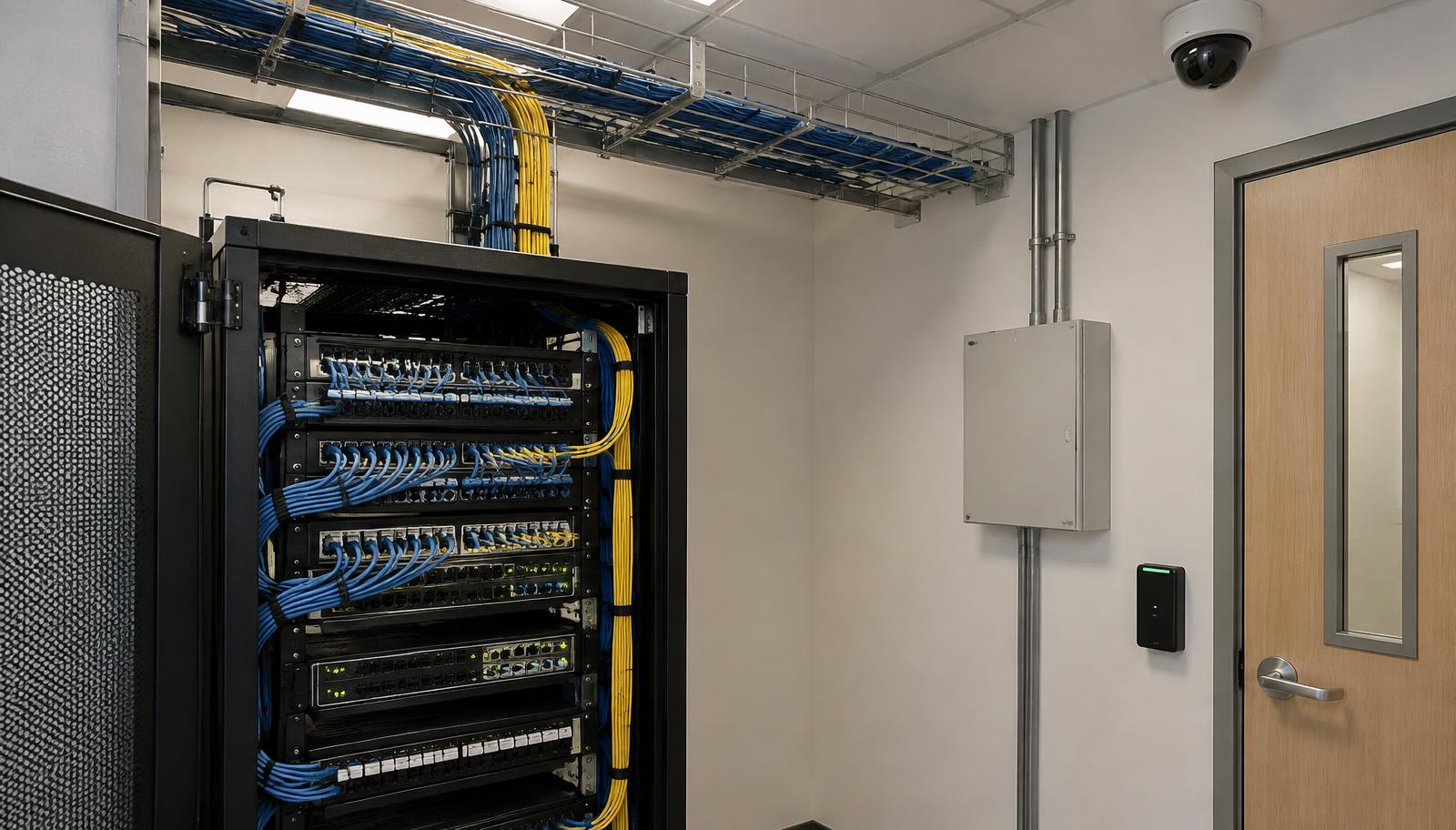
Communications rooms, equipment cabinets and racks need sufficient capacity for the equipment being installed and sensible allowance for maintenance and expansion.
Power arrangements should be appropriate for the equipment and operational requirement. Where systems are critical, suitable backup power may be necessary.
Heat also matters.
A communications room that previously contained a small amount of equipment may behave differently after additional switches, PoE loads, servers or recording systems are installed.
Cable management should allow technicians to trace and maintain the environment without disturbing unrelated connections.
These details may appear secondary during procurement, yet they have a direct effect on reliability and supportability.
A neat communications room is not valuable merely because it looks professional. It is valuable because technicians can understand it, work safely and make changes with less risk.
Site readiness determines whether deployment can begin
Even a well-designed system cannot be installed effectively on a site that is not ready.
Before deployment teams are dispatched, practical dependencies should be confirmed.
Access to the work areas needs to be available. Device locations should be agreed. Electrical work required for the deployment should be complete. Cable routes, containment, sleeves or trenches should be available where another contractor is responsible for providing them.
Communications cabinets and equipment rooms need to be sufficiently complete for the work planned.
Equipment should also be physically available at the installation location.
The fact that hardware has been delivered somewhere within an organisation does not necessarily mean technicians can access it at the site where the deployment is taking place.
Multi-contractor environments make readiness particularly important.
A technology team may depend on construction, electrical, ceiling, door or civil works being completed first. If those dependencies are not verified before mobilisation, project time is easily lost.
A short readiness review before dispatch can therefore prevent repeated travel, aborted installations and pressure to recover schedule later.
Resilience should follow business impact
Resilience is important, but it should be designed according to consequence rather than habit.
Not every component requires redundancy.
The useful question is what happens when a particular component fails.
A small office may tolerate a short connectivity interruption. A warehouse relying on networked operational and security systems may be affected much more severely.
The same principle applies to fibre links, switches, internet connections, power supplies and communications rooms.
A readiness assessment should identify meaningful single points of failure and relate them to business impact.
This allows resilience investment to be targeted where it produces real operational value.
For one organisation that may mean secondary internet connectivity. For another it may mean redundant fibre between buildings. A third may determine that keeping a spare switch on site offers greater practical value than duplicating the complete network.
There is no universal answer.
The objective is to make the dependency visible before deciding what level of resilience is justified.
Documentation and change control preserve infrastructure value
Infrastructure becomes difficult to support when nobody is certain how it is constructed.
Accurate documentation reduces that uncertainty.
Useful records may include logical network diagrams, rack layouts, cable identifiers, fibre routes, IP addressing, VLAN structures, equipment lists and configuration information.
The level of documentation should reflect the complexity of the environment.
What matters is that another competent person can understand the infrastructure without rediscovering it from the beginning.
Documentation also needs to survive change.
A drawing that was accurate on commissioning day becomes less useful every time the infrastructure changes without the record being updated.
This is why change control matters.
It does not need to be a complicated bureaucracy. It means ensuring that important infrastructure changes are recorded consistently enough that the technical record continues to reflect reality.
That becomes especially important where several contractors or service providers work on the same environment.
Multi-site environments need an operating model
The challenge increases when infrastructure is distributed across several locations.
Different sites may have different connectivity providers, equipment generations, building layouts and operational requirements.
Trying to force complete uniformity across every location is rarely practical.
A better objective is controlled consistency.
Organisations can establish common naming conventions, documentation standards, network principles, security controls, equipment preferences and support processes while still allowing individual sites to differ where the business requirement justifies it.
Remote visibility becomes increasingly valuable as distance grows.
Central management tools, accurate documentation and clear site contacts can reduce the need to send a technician simply to establish what has happened.
Support arrangements should also be designed deliberately.
Organisations need to know who responds to faults, how incidents are escalated, where spares are held and when specialist resources need to travel to site.
Infrastructure management continues long after installation is complete.
A project should therefore consider not only how the system will be deployed, but how it will be operated.
Turn the assessment into a prioritised deployment plan
A readiness review should produce decisions rather than simply identify problems.
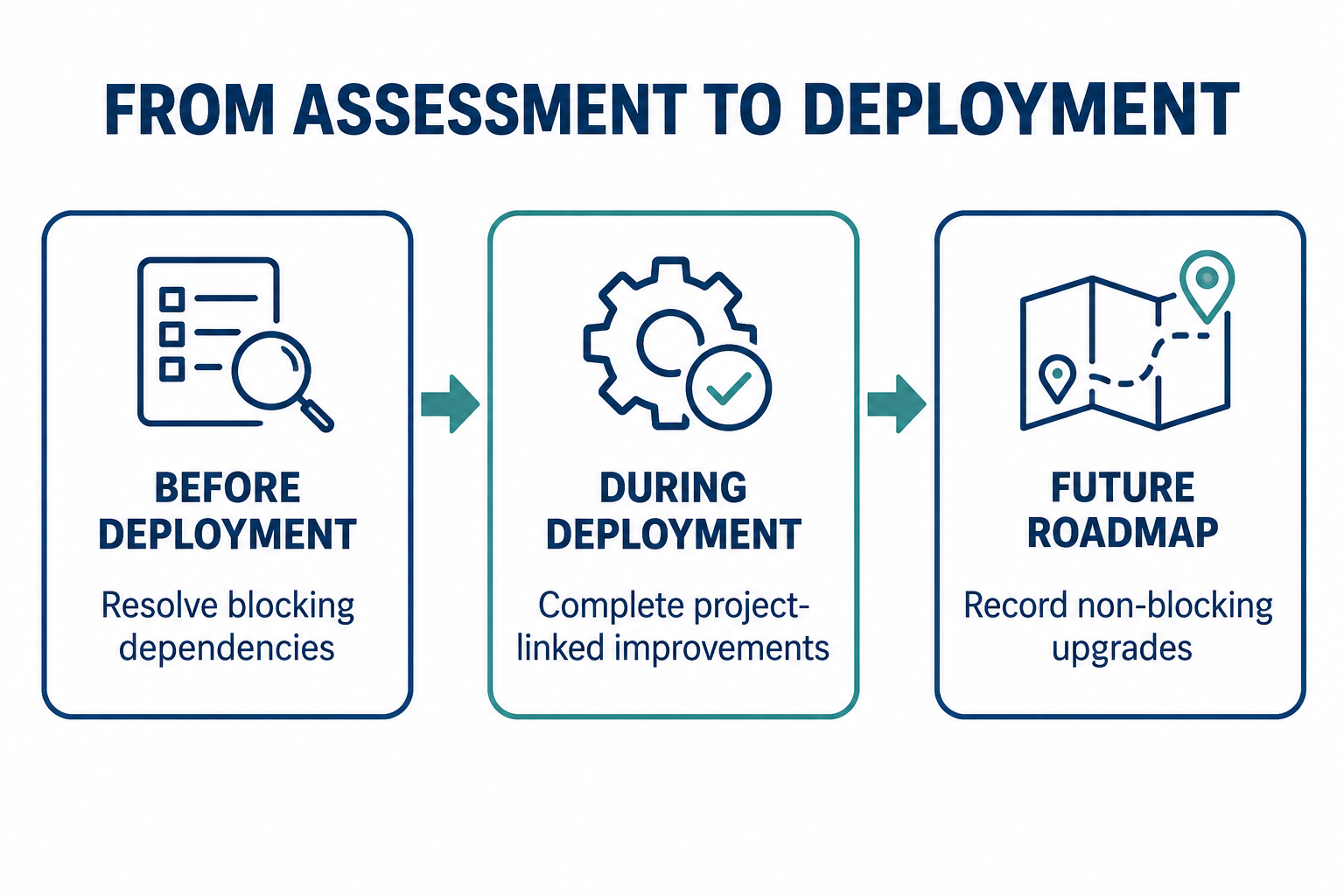
The findings can usually be separated into three broad groups.
Some issues must be resolved before deployment begins because the project depends on them.
Other improvements can be incorporated into the deployment itself.
A third group may be documented for future attention without affecting the immediate project.
This distinction is important because infrastructure assessment should not automatically become a justification for replacing everything.
Existing infrastructure may still be entirely suitable.
The value of the process lies in identifying the actual constraints.
A business may discover that its switches and cabling remain suitable but certain communications rooms need work. Another may find that its internal network is capable while several inter-building fibre routes represent unacceptable single points of failure.
The resulting plan should therefore reflect risk, dependency and business priority.
Where possible, responsibilities should also be clear.
If the technology deployment depends on another contractor completing electrical work, that dependency should have an owner and an agreed date. If the client needs to confirm final camera positions, that decision should be resolved before the installation team arrives.
The more uncertainty that can be removed before mobilisation, the more predictable the deployment becomes.
Enterprise Infrastructure Readiness Checklist
Use this checklist before mobilising an installation team. An item that cannot yet be ticked does not always block deployment, but it should have a named owner and a date for resolution.
Site & Access
- Site access confirmed
- Required permits / inductions confirmed where applicable
- Work areas accessible
- Site contact confirmed
- Working hours / access restrictions confirmed
Design & Scope
- Latest drawings confirmed
- Final device positions approved
- Current bill of quantities confirmed
- Scope changes resolved
- Dependencies on other contractors identified
Power & Communications Rooms
- Required electrical power available
- Communications rooms accessible
- Racks installed and ready
- Sufficient rack space available
- Backup power requirements identified
- Ventilation / cooling adequate where required
Cabling & Fibre
- Cable routes confirmed
- Containment / sleeves / trenches ready
- Structured cabling installed where required
- Existing cabling tested where it will be reused
- Fibre routes confirmed
- Fibre capacity checked
- Patch panels and termination points identified
Network
- Switching capacity checked
- Available ports confirmed
- PoE capacity checked
- Uplink / backbone capacity assessed
- IP addressing requirements agreed
- VLAN / segmentation requirements agreed
- Internet / WAN connectivity available where required
Wireless
- Wireless coverage requirements confirmed
- Access-point locations reviewed
- PoE and cabling available for access points
- Environmental factors considered where relevant
CCTV
- Camera positions approved
- Mounting surfaces ready
- Cabling / PoE available
- Recording architecture confirmed
- Network capacity assessed
- Storage requirements confirmed
Access Control
- Door types confirmed
- Locking hardware confirmed
- Power supplies available
- Cable routes ready
- Controller locations agreed
- Emergency / life-safety interfaces confirmed where applicable
Equipment
- Required equipment physically on site
- Equipment allocated to the correct site
- Accessories / mounting hardware available
- Outstanding equipment identified before dispatch
- Responsible party for missing equipment confirmed
Security & Resilience
- Network segmentation considered
- Remote-access requirements agreed
- Administrator access controlled
- Critical single points of failure identified
- Backup connectivity considered where justified
- Backup power considered where justified
Documentation & Handover
- Network diagrams current
- Rack layouts current
- Cable / port labelling standard agreed
- Equipment records prepared
- Fibre routes documented
- Configuration changes to be recorded
- Handover requirements agreed
Deployment Approval
- Blocking dependencies resolved
- Responsible parties have confirmed readiness
- Installation team has current scope
- Site visit / mobilisation confirmed
- Deployment date approved only once readiness is verified
Conclusion
Enterprise technology does not operate independently of the environment around it.
Cloud platforms still depend on local networks and connectivity. CCTV systems depend on cabling, switching, storage and power. Access control interacts with both the network and the physical building. Wireless performance depends on radio conditions as well as the infrastructure supporting each access point.
This is why infrastructure readiness should be treated as part of technology planning rather than as a check performed once equipment has already been ordered.
The purpose is not to delay projects.
It is to make them more predictable.
A useful readiness assessment establishes what is already present, identifies where capacity or condition could become a constraint and separates urgent requirements from improvements that can be phased over time.
That information allows organisations to spend more deliberately.
It also gives project teams a clearer basis for design, mobilisation and commissioning.
New technology is often the visible part of an infrastructure project. The reliability of that technology, however, depends heavily on decisions made before installation begins.
Understanding the environment first is therefore not an additional project phase.
It is part of designing the project properly.
Related services
Related insights
Managing Technology Infrastructure Across Multi-Site Operations
Multi-site technology environments can become difficult to manage when each location evolves independently. Standardisation, documentation, connectivity, security, remote support and change control help organisations keep distributed infrastructure reliable without forcing every site into an identical design.
Why Site Readiness Matters Before ICT and Security Deployment
A technically sound CCTV, access-control or network design can still run into trouble if the site is not ready for installation. Clear access, confirmed drawings, completed power, prepared cable routes and equipment availability should be established before deployment teams are dispatched.
Designing Integrated CCTV, Access Control and Network Infrastructure
CCTV, access control and enterprise networks are becoming increasingly interconnected. Successful deployments depend on more than choosing cameras or readers: cabling, switching, PoE, segmentation, power, equipment rooms and resilience all need to be considered as part of one infrastructure environment.
Structured Cabling for Modern Enterprise Environments
Enterprise networks increasingly carry far more than ordinary user traffic. CCTV, access control, wireless access points, voice systems and connected devices all depend on the same physical infrastructure. Good structured cabling is therefore less about installing cable and more about creating a reliable foundation for everything connected to it.
Enterprise Network Readiness: What to Review Before a Major Technology Upgrade
Technology upgrades can fail for reasons that have little to do with the new system itself. Ageing cabling, overloaded switches, weak wireless coverage, poor documentation and inadequate power or resilience can all become bottlenecks. A network-readiness assessment helps identify those constraints before deployment begins.