Enterprise Network Readiness: What to Review Before a Major Technology Upgrade
A major technology upgrade can expose weaknesses that have been hidden in an organisation's network for years. Before adding new cloud platforms, security systems, wireless infrastructure or connected devices, businesses should understand whether the physical and logical network underneath them is actually ready.
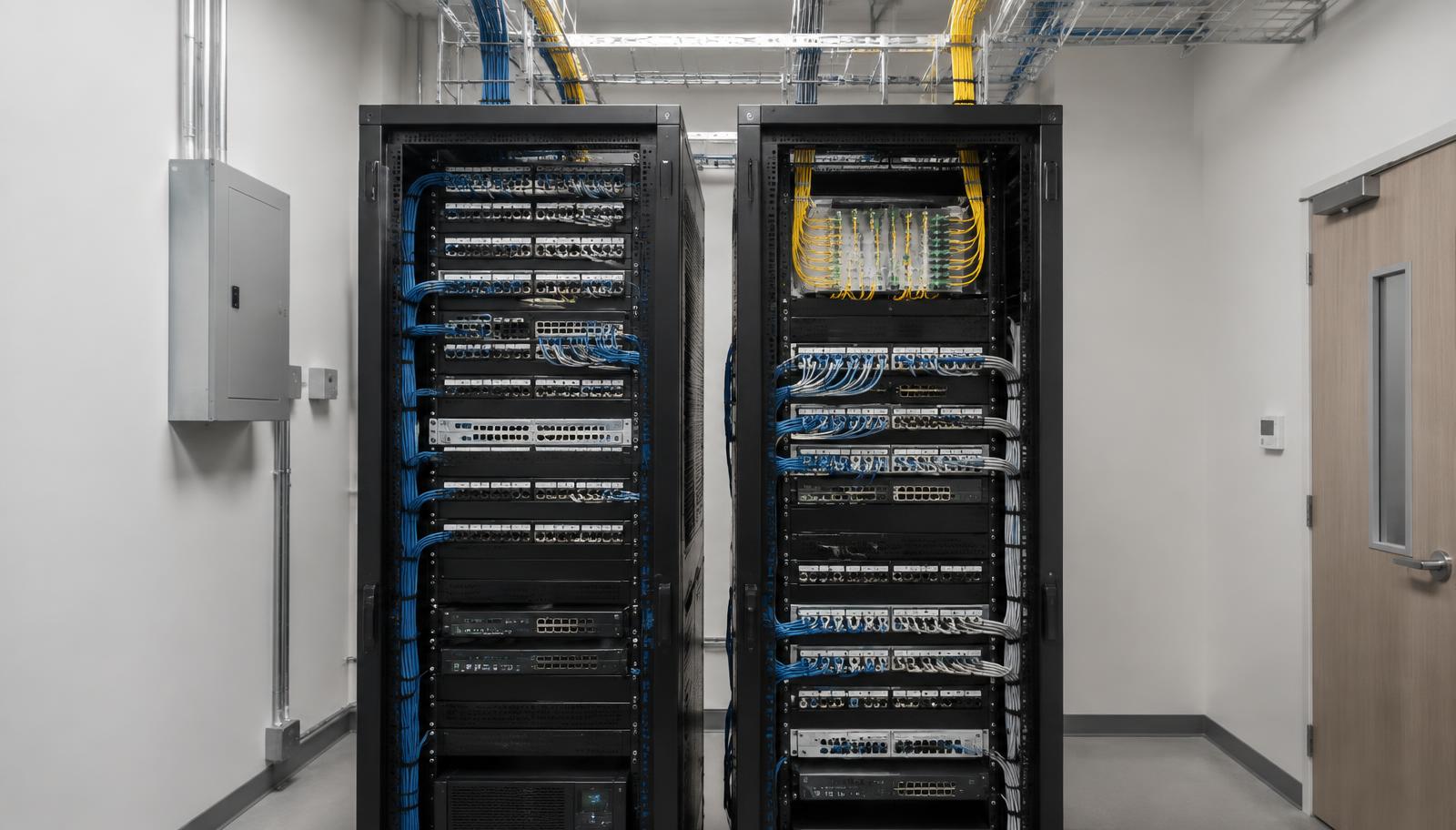
Technology projects are usually planned around whatever new system is being introduced. A business may be preparing to migrate more applications to the cloud, expand its wireless network, install a new CCTV platform, introduce access control or connect more devices across its sites. Attention naturally turns to the new equipment, software and features being purchased.
The infrastructure underneath those systems often receives less attention. In many organisations, the network has developed gradually over years of office moves, extensions, emergency repairs and upgrades delivered by different contractors. Cabling may no longer be accurately documented, switches may be closer to capacity than expected, and communications rooms may contain equipment that has been added without anyone stepping back to assess the environment as a whole.
Most of these weaknesses remain hidden while the network is doing roughly what it has always done. They become visible when something new is added. A major technology upgrade is therefore a useful point at which to understand what is actually installed, what remains suitable and where existing infrastructure could become a constraint.
Understand what is already there
The starting point should be a reliable picture of the current environment. Existing network diagrams and asset registers are useful, but they should not automatically be assumed to reflect what is physically installed today. A switch may have been replaced without documentation being updated, additional cabling may have been introduced during a renovation, or fibre routes may have changed as sites expanded.
Physical verification is therefore important. Switches, routers, wireless access points, fibre links, structured cabling, patch panels, equipment racks and connected systems should be assessed against the available documentation. The objective is not paperwork for its own sake. It is to avoid designing an upgrade around assumptions that later turn out to be wrong.
Structured cabling deserves particular attention because it often remains in service far longer than the active equipment connected to it. An organisation may replace its switches several times while retaining much of the original copper and fibre infrastructure. Before relying on that cabling for a new deployment, it is worth understanding what is installed, how it has been terminated, whether links have been extended or altered over time and whether existing runs are still capable of supporting the speeds and power requirements expected from the new environment.
Where existing cabling is going to remain in service, testing can be more valuable than assumption. It is generally easier to identify a weak or marginal link before commissioning than to troubleshoot intermittent failures once users and systems are already relying on it.
Capacity is more complicated than internet speed
Network capacity is often reduced to the speed of the organisation's internet connection. External connectivity certainly matters, particularly as more applications move to cloud platforms, but it is only one part of the path that data follows.
Switch uplinks, fibre backbones, links between buildings and wireless infrastructure all have their own limits. A business can have a fast internet service while still experiencing poor performance because congestion exists elsewhere in the network.
This becomes more important as different systems begin sharing the same infrastructure. Office traffic, voice services, wireless devices, CCTV cameras, access-control systems and other connected equipment can all place different demands on the network. Video traffic, for example, can create a sustained load that looks very different from normal office usage.
Power over Ethernet introduces another consideration. A switch may have enough physical ports available while having very little unused power capacity. This can become a problem when additional cameras, access points, phones or access-control devices are added, particularly if newer equipment requires more power than the devices it replaces.
Wireless capacity needs the same level of attention. A strong Wi-Fi signal does not necessarily mean that an access point can support the number of users or volume of traffic expected in an area. Building materials, interference, user density, roaming requirements and the placement of access points all influence actual performance. Warehouses, workshops and industrial environments can be particularly challenging because large spaces, metal structures and changing layouts can alter radio conditions considerably.
A useful readiness assessment therefore looks at the entire route between the user or device and the services it depends on, rather than testing only the internet connection.
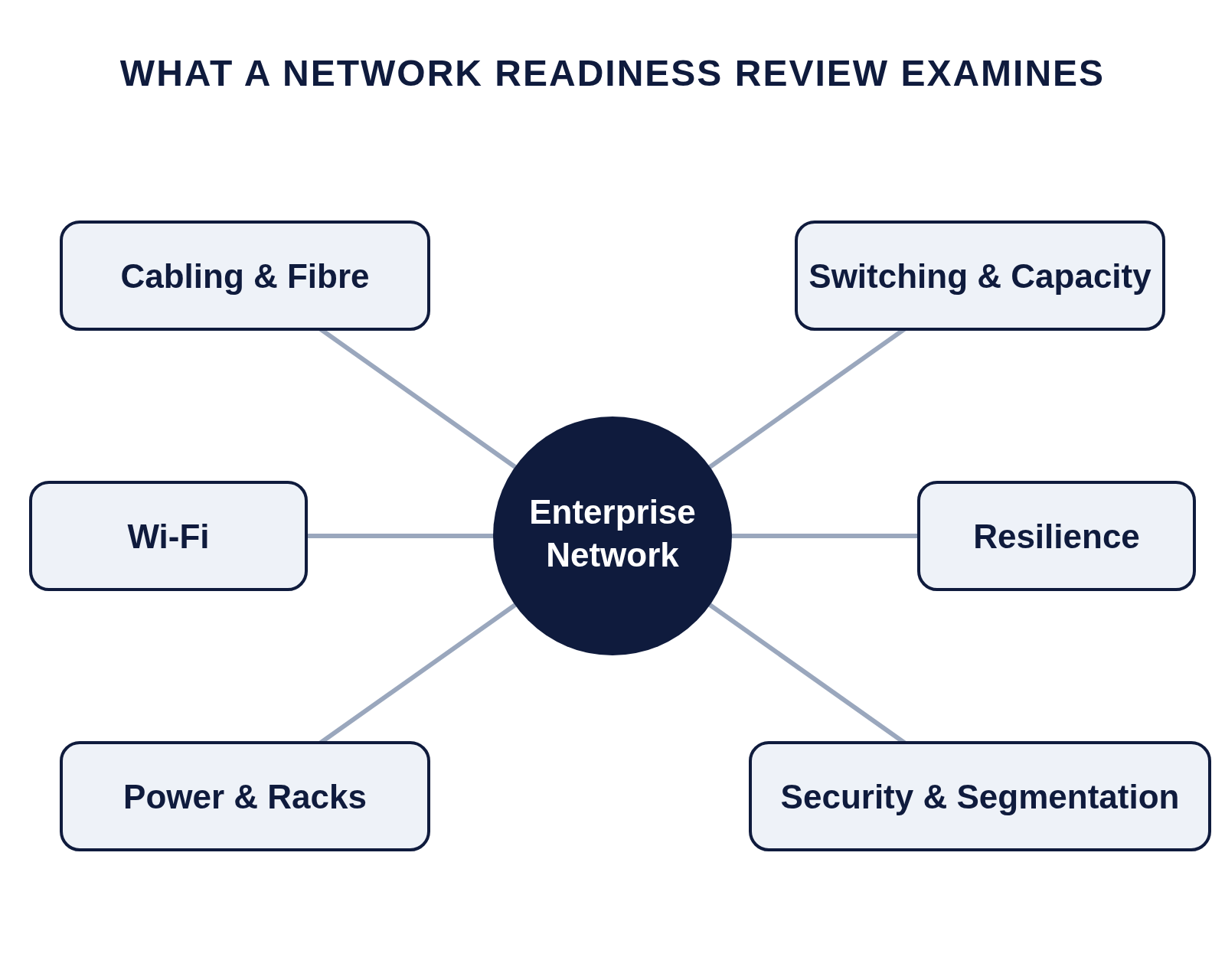
A useful readiness review considers the network as one connected environment rather than a collection of individual devices.
Security is now part of the infrastructure discussion
As more operational systems use IP networks, the boundary between traditional IT and other building technology has become less clear. CCTV cameras, access-control systems, printers, wireless infrastructure and user computers may all depend on the same switches and fibre links.
They do not necessarily need to operate as though they are part of the same network.
Segmentation can help separate systems according to function and risk, limit unnecessary communication between devices and make the overall environment easier to manage. The precise architecture will depend on the organisation, but these decisions are easier to make before a new system is introduced than after it has already been commissioned.
Remote access and device-management interfaces deserve similar attention. A new system may be technically functional while still being poorly integrated into the organisation's broader security model. Infrastructure readiness is therefore not only about whether devices can communicate. It also includes whether that communication is being controlled appropriately.
Physical security matters as well. Important network switches, fibre termination points and other critical equipment may sit in communications rooms that receive far less scrutiny than the systems they support. An organisation can invest heavily in cybersecurity while leaving the physical network infrastructure accessible to anyone who can enter an unlocked equipment room.
Power, racks and resilience are easy to overlook
The condition of a communications room often says a great deal about how an infrastructure environment has evolved. Equipment may have been added gradually until racks become crowded, patching becomes difficult to trace or power arrangements no longer reflect the amount of equipment installed.
A network-readiness review should consider whether there is sufficient rack space for expansion, whether patching is organised in a way that technicians can maintain easily and whether the available power infrastructure is appropriate for the equipment being used. Cooling and ventilation can also become important where the density of equipment has increased significantly since the room was first designed.
The same assessment should identify meaningful single points of failure. That does not mean every organisation needs duplicate infrastructure everywhere. Resilience should be based on the consequences of failure.
A small office may be able to tolerate a short interruption to an internet connection. A warehouse relying on networked security and operational systems may have a very different risk profile. A multi-site organisation could be heavily dependent on a single fibre route or one central switch that affects several functions if it fails.
Understanding those dependencies allows investment to be directed where a failure would have a disproportionate impact rather than attempting to make every component redundant.
Good documentation reduces future project risk
A network can be technically operational while still being difficult to manage because too little is known about how it has been assembled. That becomes particularly costly when a fault occurs or another project begins.
Useful documentation does not need to become an enormous exercise. At a minimum, organisations should be able to understand the logical network layout, important fibre routes, core switching, rack layouts, VLAN assignments and the purpose of critical connections. In larger or multi-site environments, maintaining this information becomes increasingly important.
The value becomes obvious when a different technician or service provider needs to work on the system. Accurate documentation allows someone competent to understand the environment without having to rediscover its design from the beginning.
It also makes future upgrades easier to plan because the organisation has a clearer picture of what can remain in service and what needs attention.
Upgrade the constraint rather than replacing everything
A network-readiness assessment should not automatically result in a recommendation to replace the entire environment. In many organisations, much of the existing infrastructure may still be perfectly suitable for the next stage of development.
The purpose is to identify the parts of the environment that are likely to constrain the proposed project. One organisation may find that its switching environment is adequate but several fibre links require attention. Another may have suitable cabling but poor wireless coverage. A third may discover that the network itself is capable while its power arrangements, racks and documentation are the real weaknesses.
A targeted upgrade is usually more useful than replacing equipment simply because it is old. The assessment should distinguish between what needs to be addressed before deployment, what can be improved as part of the project and what can safely remain in service.
That sequence also helps control project risk. Many deployment problems are caused not by the technology being installed, but by assumptions that were never tested beforehand. A CCTV project may depend on network capacity that was never measured. A wireless deployment may be designed from floor plans without understanding actual radio conditions. Equipment may arrive on site before network points, power or communications rooms are ready.
These are manageable issues when identified early. They become expensive when equipment, installers and project deadlines are already involved.
The visible part of a technology project may be the new system being installed. Its reliability, however, often depends on infrastructure that was there long before the project began. Understanding that environment before deployment is one of the simplest ways to reduce surprises later.