Designing Integrated CCTV, Access Control and Network Infrastructure
Modern CCTV and access-control systems increasingly depend on the same network, fibre, switching, power and communications infrastructure used by the rest of the business. Treating security and ICT as completely separate projects can create avoidable problems during installation and long after commissioning.
By Devjee International6 min read
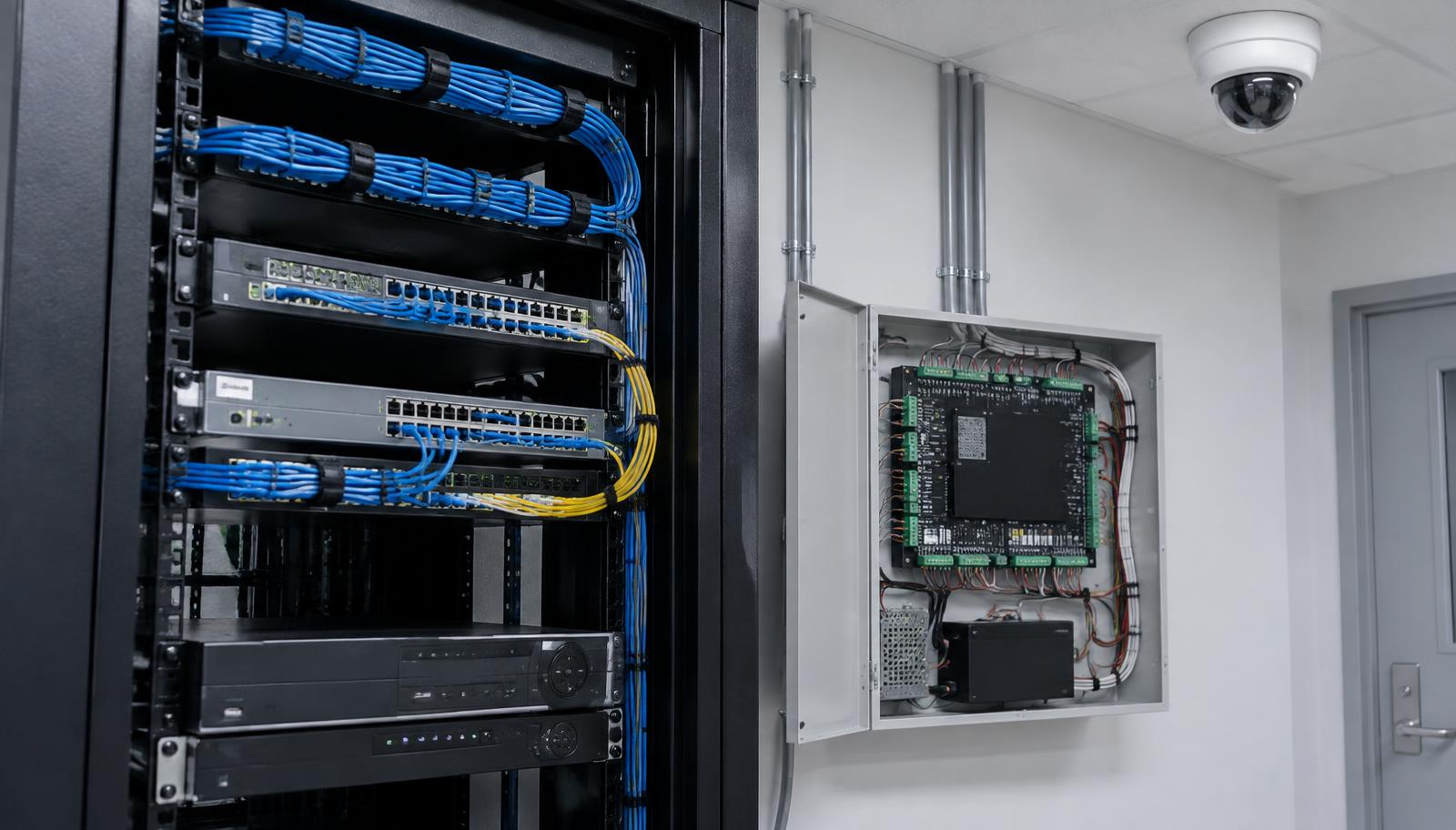
Modern security systems no longer operate at the edge of an organisation's technology environment. CCTV cameras, access-control controllers, intercoms and other connected devices increasingly rely on the same network infrastructure that supports users, wireless systems, voice services and cloud applications.
That convergence has changed how security projects should be planned.
A CCTV project may begin with questions about camera coverage, recording and image quality. An access-control project may focus on doors, readers, credentials and permissions. Those remain important, but both systems ultimately depend on physical and digital infrastructure that often sits outside the traditional security specification.
The network has to carry the traffic. Cabling has to reach the devices. Switches need sufficient ports and power capacity. Equipment rooms need space and suitable power. Remote connections need to be controlled. If these elements are treated as somebody else's problem until installation begins, otherwise straightforward projects can become unnecessarily difficult.
The practical lesson is that modern security infrastructure should be designed as part of the wider technology environment rather than added to it afterwards.
Start with the operational requirement
Good security design begins with what the organisation is trying to achieve, not with a list of devices.
A camera should exist for a reason. It may need to provide identification at an entrance, monitor a loading area, observe activity around a perimeter or give operators situational awareness across a site. The requirement determines the field of view, placement, image detail, lighting considerations and ultimately the type of infrastructure needed to support the camera.
The same applies to access control. A simple internal office door presents a different operational requirement from a vehicle entrance, server room or high-traffic facility entrance. Door hardware, emergency-release requirements, controller placement, network connectivity and backup power can all differ.
Working from the operational requirement first helps prevent a common problem: infrastructure being installed before device locations and system responsibilities have been properly agreed.
That is particularly important on construction or refurbishment projects, where security infrastructure often has to coordinate with ceilings, electrical works, doors, walls, pathways and other trades. A network point in the wrong location is not merely inconvenient once finishes are complete.
Early coordination reduces the number of compromises that have to be made later.
CCTV places specific demands on the network
Video traffic behaves differently from ordinary office traffic. Cameras can generate continuous data for long periods, and the aggregate load becomes significant as the number of devices and image settings increase.
This does not mean every CCTV project requires a separate physical network. It does mean the expected traffic should be understood before equipment is connected.
Switch capacity, uplinks and backbone infrastructure all matter. A group of cameras connected to an access switch may operate without difficulty until all of their traffic has to cross a constrained uplink to reach recording or monitoring systems elsewhere on the site.
Storage architecture can also influence the network design. Recording may take place locally, centrally or across multiple locations, and operators may need live and recorded access from different parts of the organisation. Those traffic patterns should be considered rather than discovered during commissioning.
Power over Ethernet adds another layer. IP cameras are convenient to deploy through PoE, but the switch must have both enough ports and enough total power capacity for the connected devices. Higher-performance cameras, additional illuminators and other accessories can affect that calculation.
The important point is not to over-engineer every CCTV network. It is to understand the actual load and design the infrastructure accordingly.
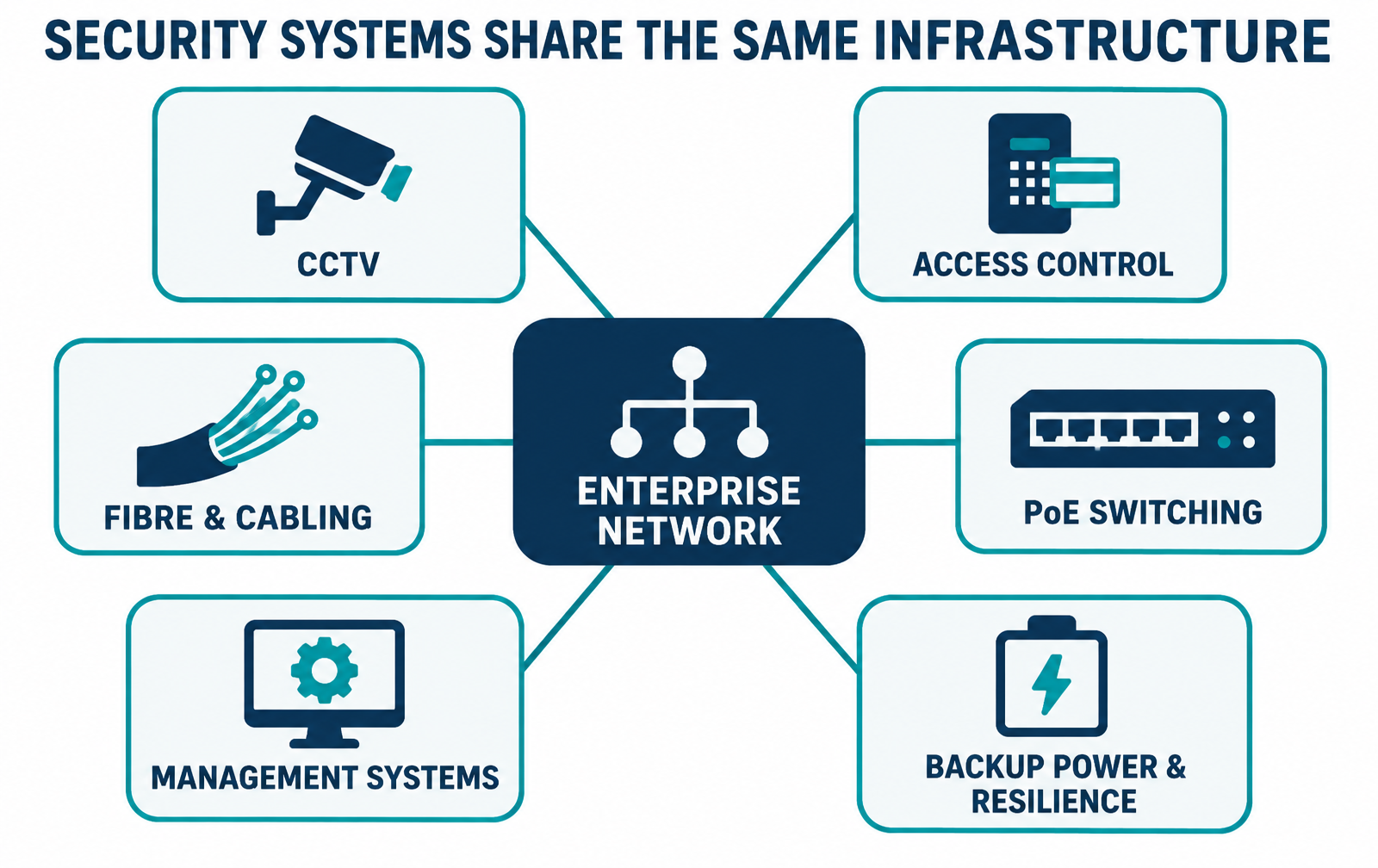
Modern security platforms increasingly depend on the same underlying network and physical infrastructure as other enterprise systems.
Access control depends on more than the network point
Access-control infrastructure tends to interact more directly with the physical building than many other technology systems.
A reader may be visible to the user, but the complete door environment can include controllers, locks, power supplies, request-to-exit devices, emergency-release mechanisms, door contacts and interfaces with other building systems.
That means responsibilities need to be clear before installation begins.
Who provides the door hardware? Where will controllers be located? Is suitable power available? Have cable routes been prepared? Are fire and life-safety interfaces required? Is the final door construction compatible with the selected equipment?
These questions are much easier to resolve during design than when technicians arrive to commission the system.
Network connectivity should also be planned deliberately. Controllers and management systems may need to communicate across the enterprise network or between sites. That traffic should be accommodated within the wider network architecture without giving devices unnecessary access to unrelated systems.
As with CCTV, the objective is not simply to get a device online. It is to integrate it into an environment that can be operated, maintained and secured over time.
Segmentation helps separate different responsibilities
A modern enterprise can have hundreds or thousands of connected devices, not all of which need to communicate with one another.
Security equipment is a good example.
An IP camera may need to communicate with a recorder, management platform, time service or other authorised infrastructure. It generally does not need unrestricted access to ordinary user devices throughout the organisation.
Access-control devices have similarly specific communication requirements.
Network segmentation allows organisations to group systems according to function and apply appropriate controls between them. The precise architecture may use VLANs, firewall policies or other network controls depending on the environment.
This can improve security, but it also makes systems easier to understand. When CCTV, access control, user devices and other equipment are logically organised, troubleshooting and future changes can become more manageable.
Segmentation should therefore be part of the design conversation rather than something applied only after security devices have already been connected to the network.
Equipment rooms, power and resilience affect the whole system
Security infrastructure is often distributed across a site, but important components still converge in communications rooms, equipment cabinets and control areas.
Those locations need enough rack space, power and cable-management capacity for the equipment being installed. They should also allow reasonable access for maintenance without exposing critical infrastructure unnecessarily.
Backup power deserves careful consideration. Different parts of a security system may respond differently during an interruption. Cameras, switches, access-control controllers, locks, servers and communications equipment can all have their own power requirements.
The required level of resilience should follow the operational risk.
Not every camera needs infrastructure designed as though the site were a critical national facility. At the same time, an access-control system protecting important areas may need a more considered response to power or network failure than ordinary office equipment.
The design should therefore identify which failures matter most and where backup infrastructure produces meaningful operational value.
The same thinking applies to network resilience. A single fibre link, switch or communications cabinet can become a significant point of failure if too many security functions depend on it.
Understanding those dependencies before construction allows the organisation to decide where resilience is justified rather than discovering the dependency after a fault.
Integration should make the environment simpler to operate
Combining infrastructure does not mean every system has to become one large platform.
The value of integration is often much more practical.
CCTV, access control and network infrastructure can share pathways, fibre backbones, equipment rooms and management principles while still retaining appropriate logical separation. Documentation can use consistent naming and location references. Device addressing and network segmentation can follow agreed conventions. Fault-finding can begin from a shared understanding of how the site is connected.
That becomes increasingly valuable on larger or multi-site environments.
When different contractors deliver individual systems without an agreed infrastructure approach, the organisation can inherit separate drawings, inconsistent labels and overlapping assumptions about responsibility. The systems may all function, but operating them together becomes more difficult than necessary.
A coordinated design reduces that fragmentation.
It also improves future expansion. Adding cameras, readers or new buildings becomes easier when spare capacity, backbone routes and communications infrastructure have been planned with growth in mind.
Modern security systems are ultimately technology systems installed in physical environments. Their reliability depends on both sides of that equation.
Camera placement, door hardware and operational requirements still matter. So do fibre routes, switches, PoE capacity, power, racks, segmentation and network resilience.
Projects tend to work better when those decisions are made together rather than handed from one discipline to another after the design is already fixed.
Related services
Related insights
Structured Cabling for Modern Enterprise Environments
Enterprise networks increasingly carry far more than ordinary user traffic. CCTV, access control, wireless access points, voice systems and connected devices all depend on the same physical infrastructure. Good structured cabling is therefore less about installing cable and more about creating a reliable foundation for everything connected to it.
Enterprise Network Readiness: What to Review Before a Major Technology Upgrade
Technology upgrades can fail for reasons that have little to do with the new system itself. Ageing cabling, overloaded switches, weak wireless coverage, poor documentation and inadequate power or resilience can all become bottlenecks. A network-readiness assessment helps identify those constraints before deployment begins.