Structured Cabling for Modern Enterprise Environments
Structured cabling rarely receives the same attention as switches, servers or wireless equipment, yet it can remain in service for far longer than almost any other part of the network. A well-planned cabling environment gives businesses room to expand, troubleshoot and modernise without rebuilding the physical network every time technology changes.
By Devjee International6 min read
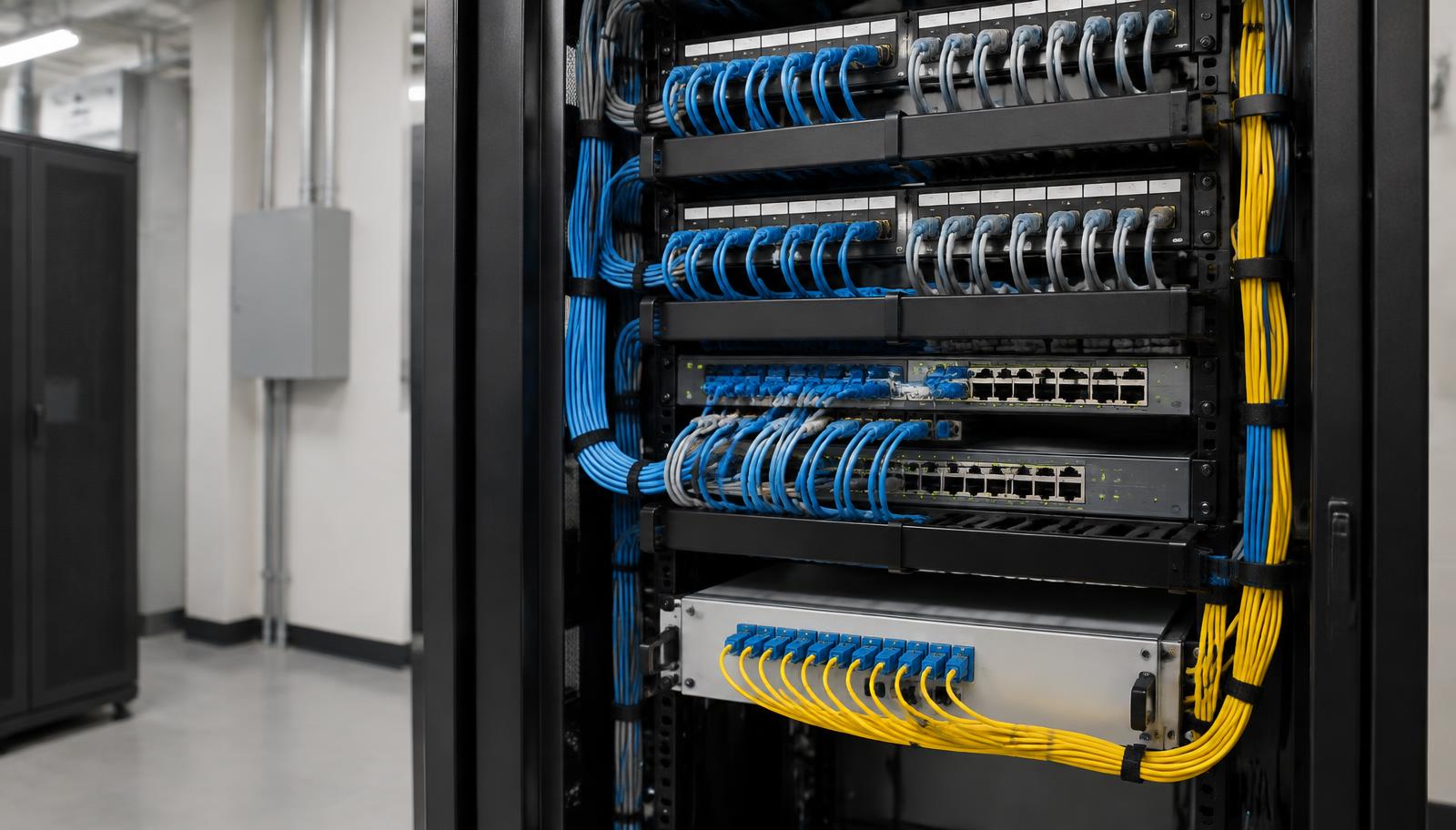
When an organisation plans a network upgrade, most of the attention usually goes to active equipment. Switches are compared, wireless access points are specified, firewalls are selected and new systems are discussed in terms of speed, coverage and functionality.
The cabling underneath all of that tends to receive much less attention.
That is understandable. Structured cabling is largely invisible once a building is operational. It sits above ceilings, below floors, inside trunking and behind patch panels. If the network appears to be working, there is little reason for most users to think about it.
For infrastructure teams, however, the physical layer can determine how easily an environment grows, how quickly faults can be located and whether new technology performs as expected. Unlike active network equipment, which may be replaced several times during the life of a building, a properly designed cabling installation can remain in service for many years.
The decisions made during installation therefore matter long after the original project has been completed.
The network now carries much more than office traffic
Enterprise cabling once primarily connected desktop computers, printers and telephones. Modern environments are considerably more demanding.
The same physical network may now support user workstations, wireless access points, IP cameras, access-control equipment, voice systems, printers, sensors and other connected devices. Cloud-based applications have increased the importance of reliable connectivity, while Power over Ethernet allows many devices to receive both data and power through the same cable.
This convergence has made the cabling environment more important, not less.
A camera installation, for example, is no longer only a security project. It may place sustained traffic on the network, require PoE from access switches and depend on uplinks between buildings or communications rooms. Wireless access points may require higher-performance connections than the equipment they replace, while newer devices can place additional demands on switch power budgets.
The result is that structured cabling increasingly supports systems that were once designed independently of one another.
That makes good planning essential. A network should not only accommodate what is being installed today; it should also provide reasonable capacity for the changes likely to arrive during the useful life of the cabling.
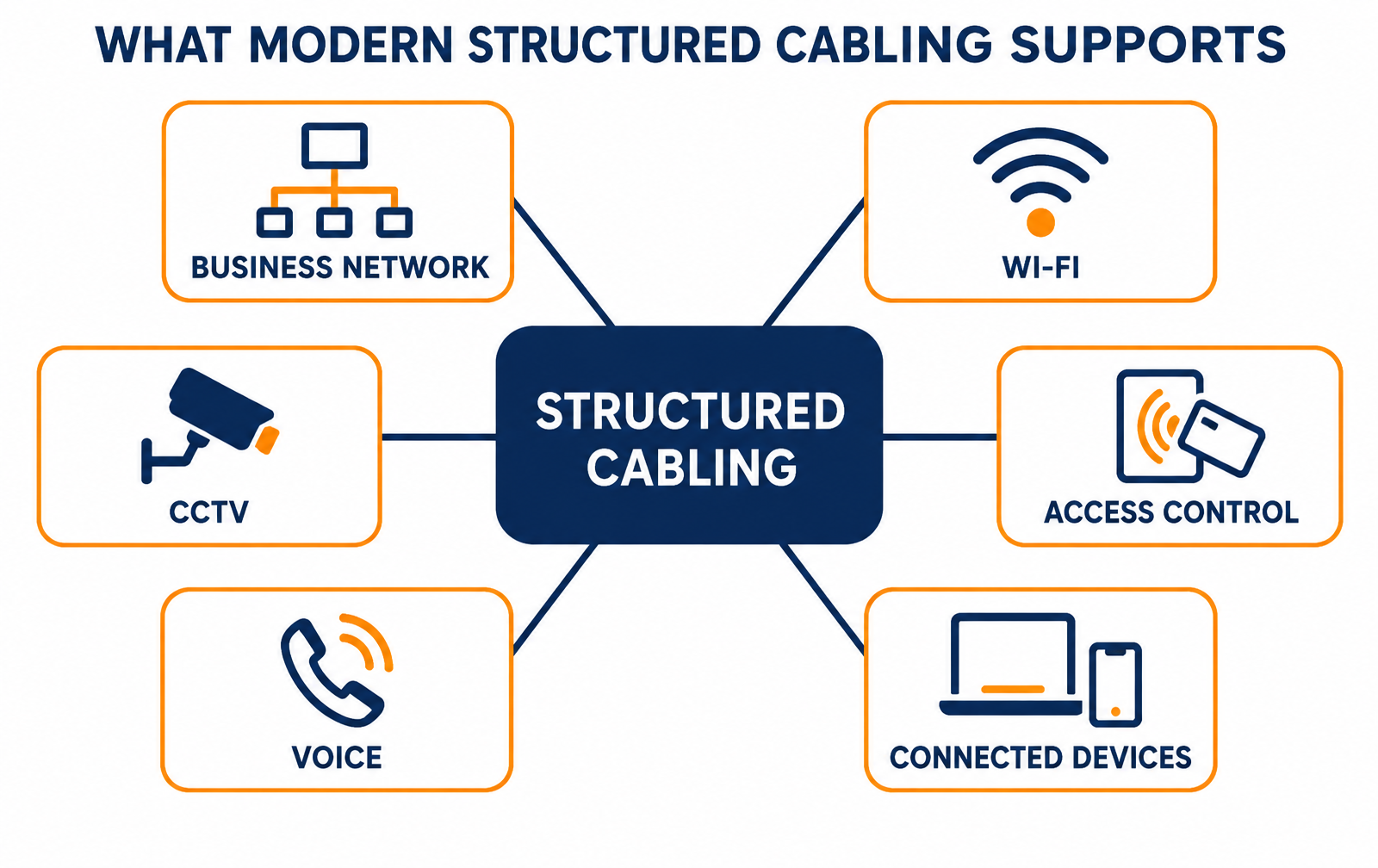
Modern cabling infrastructure increasingly supports multiple business, communications and security systems on the same physical network.
Cable selection should follow the environment
The question of which cable category to install is often treated as though there is one universal answer. In practice, the correct choice depends on the application, expected speeds, distance, building environment and how long the organisation expects the infrastructure to remain in service.
For many enterprise environments, Category 6 remains suitable for a wide range of standard network connections. Other environments may justify Category 6A where higher performance, future capacity or particular technical requirements make the additional capability worthwhile.
The important point is not simply to choose the highest specification available. It is to understand what the installation is expected to support and design accordingly.
The same principle applies to fibre.
Fibre becomes particularly important for backbone links, inter-building connections, longer distances and locations where greater bandwidth or electrical isolation is required. The choice between fibre types, core counts and termination methods should reflect both current requirements and likely future expansion.
Physical conditions also matter. A cable route through an office ceiling is very different from one crossing an industrial site or linking separate buildings. Moisture, heat, electromagnetic interference, physical exposure and fire requirements may all influence the type of cabling and containment used.
Good infrastructure design begins with the environment rather than with a product catalogue.
Installation quality matters as much as cable specification
A high-quality cable can still perform poorly if it is installed badly.
Excessive pulling tension, tight bends, damaged jackets, poor termination and inappropriate routing can all affect performance and reliability. Copper cabling installed too close to electrical infrastructure may also be exposed to interference if proper separation is not maintained.
The quality of the patching environment matters too. Communications rooms that begin as neat installations can become difficult to manage after years of additions if patch leads are poorly routed, labels are missing or ports are used without records being updated.
These problems rarely appear all at once. They develop gradually.
A new connection is added urgently and never labelled. A patch lead is moved temporarily and stays that way. A second contractor extends a network without updating the existing documentation. Eventually the rack still works, but tracing a connection takes far longer than it should.
That becomes costly during faults and upgrades.
A structured cabling project should therefore be judged not only by whether links pass data on the day of commissioning, but by whether the finished environment can be understood and maintained by someone who did not install it.
Testing is a critical part of that process. Where specified performance is required, links should be tested and results recorded rather than simply assumed to be satisfactory because devices connect successfully.
Communications rooms are part of the cabling design
Structured cabling does not end at the wall outlet.
The communications room, rack, patch panels and cable management are part of the same system. If those areas are poorly planned, even a technically sound cable installation can become difficult to operate.
Racks should provide enough capacity for both current equipment and sensible expansion. Patch panels should be organised logically, and horizontal and vertical cable management should allow changes without creating unnecessary strain or congestion.
Power and ventilation also matter.
Network racks increasingly contain switches providing PoE to cameras, wireless access points and other devices. As equipment density grows, so can heat and power requirements. A communications room designed many years ago may therefore need reassessment before significant new equipment is added.
Physical access should also be considered. Critical network infrastructure should not be treated as ordinary office furniture. Where appropriate, communications rooms and racks should be secured against unnecessary access, particularly when they support operational or security systems.
A well-designed communications room makes future maintenance easier because technicians can understand the environment quickly, isolate faults and make changes without disturbing unrelated systems.
Documentation should survive the project
One of the most common weaknesses in older network environments is not necessarily the cabling itself. It is the absence of reliable documentation.
A cable label is useful only if it corresponds with something meaningful elsewhere. Rack layouts, patch-panel numbering, outlet identifiers and fibre routes should follow a consistent system that can be understood after the installation team has left.
For multi-site organisations, this becomes even more important.
A central IT team may need to support a branch hundreds of kilometres away. Without accurate records, even a relatively simple fault can turn into a process of trial and error. Good documentation reduces that uncertainty.
It also supports future procurement and upgrades. If an organisation knows what cabling exists, where spare capacity is available and how buildings are interconnected, future projects can be scoped more accurately.
Documentation should therefore be treated as one of the deliverables of the installation, not as an optional administrative task at the end.
Good cabling should make future upgrades easier
The most useful structured cabling environments are rarely the ones with the most equipment. They are the ones that remain understandable and adaptable as the organisation changes.
That may mean leaving appropriate spare capacity in racks and pathways, planning backbone links with future requirements in mind and avoiding designs that make small changes unnecessarily disruptive.
It also means resisting the temptation to solve every requirement with a short-term extension.
There are situations where temporary solutions are unavoidable. The problem arises when temporary additions accumulate until the network becomes a collection of exceptions rather than a coherent system.
A better approach is to view structured cabling as long-term infrastructure.
When designed and installed properly, it should support several generations of active equipment and allow the organisation to expand without continually rebuilding the physical network underneath it.
This is why cabling decisions deserve more attention at the beginning of a project. The switches, cameras and access points installed today will eventually be replaced. Much of the physical infrastructure connecting them may still be there when that happens.