Managing Technology Infrastructure Across Multi-Site Operations
Running technology across several offices, warehouses, branches or operational sites is less about installing the same equipment everywhere and more about creating consistent standards, documentation, support processes and infrastructure that can be maintained over time.
By Devjee International6 min read
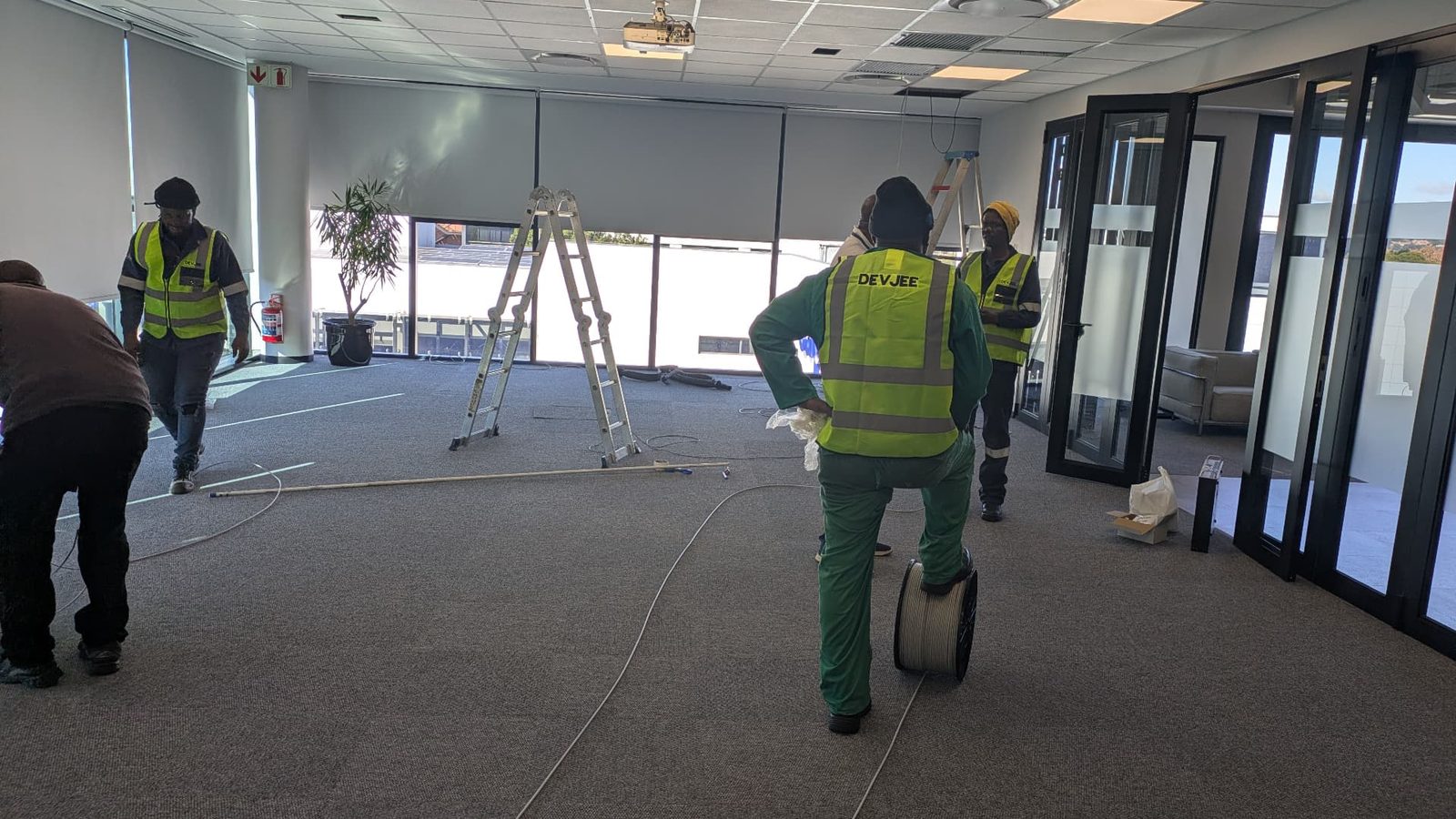
Technology is relatively easy to understand when everything sits in one building. The network can be inspected directly, equipment is within reach and local staff usually know which cabinet, switch or cable route supports a particular area.
That changes once an organisation operates across multiple locations.
A business may have a head office, regional branches, warehouses, depots, workshops or remote operational sites, each built at a different time and often supported by different people. One location may have modern switching and documented cabling, while another still depends on infrastructure installed years earlier. Internet services may come from different providers, equipment models may vary and local changes may have been made without being reflected in central records.
None of those differences is automatically a problem. Sites often have different requirements.
The difficulty begins when the organisation can no longer see the environment as one system.
Good multi-site infrastructure management is therefore less about forcing every location to look identical and more about establishing enough consistency that the estate can be understood, supported and changed without starting from zero at every site.
Standardise what should be standard
Standardisation is one of the most useful tools in a distributed environment, but it works best when applied deliberately.
An organisation does not necessarily need the same switch model, camera count or wireless design at every site. A small branch and a large warehouse may have completely different capacity requirements. What can be standardised are the principles around how the infrastructure is designed and documented.
That might include naming conventions, VLAN structures, IP addressing approaches, rack layouts, device labelling, configuration standards and the way important equipment is recorded.
A technician arriving at an unfamiliar site should not have to learn an entirely new logic each time.
The same applies to equipment selection. Where practical, reducing unnecessary variation makes support easier. If every site uses unrelated device families and management tools, the organisation eventually has to maintain expertise, spares and configuration knowledge for all of them.
Standardisation should not become rigid procurement for its own sake, but a controlled technology baseline can reduce complexity considerably.
Connectivity should be designed around the business dependency
For a multi-site organisation, connectivity between locations can become as important as connectivity within them.
Branches may depend on cloud platforms, central applications, voice services, remote monitoring or systems hosted at another location. If the link fails, the impact can extend well beyond internet browsing.
That makes it important to understand which services genuinely depend on the WAN connection and what happens when that connection is unavailable.
A site that can continue operating locally for several hours has a different resilience requirement from one that becomes effectively unusable as soon as its primary connection fails.
Secondary connectivity may therefore make sense at certain locations, but not automatically everywhere. The business impact should determine where resilience investment is justified.
Bandwidth should also be assessed in context. A site carrying ordinary office traffic will behave differently from one sending large volumes of CCTV video, supporting many wireless users or transferring operational data continuously.
The objective is not simply to buy the fastest connection available. It is to understand the traffic profile and provide enough capacity for the services the site actually uses.
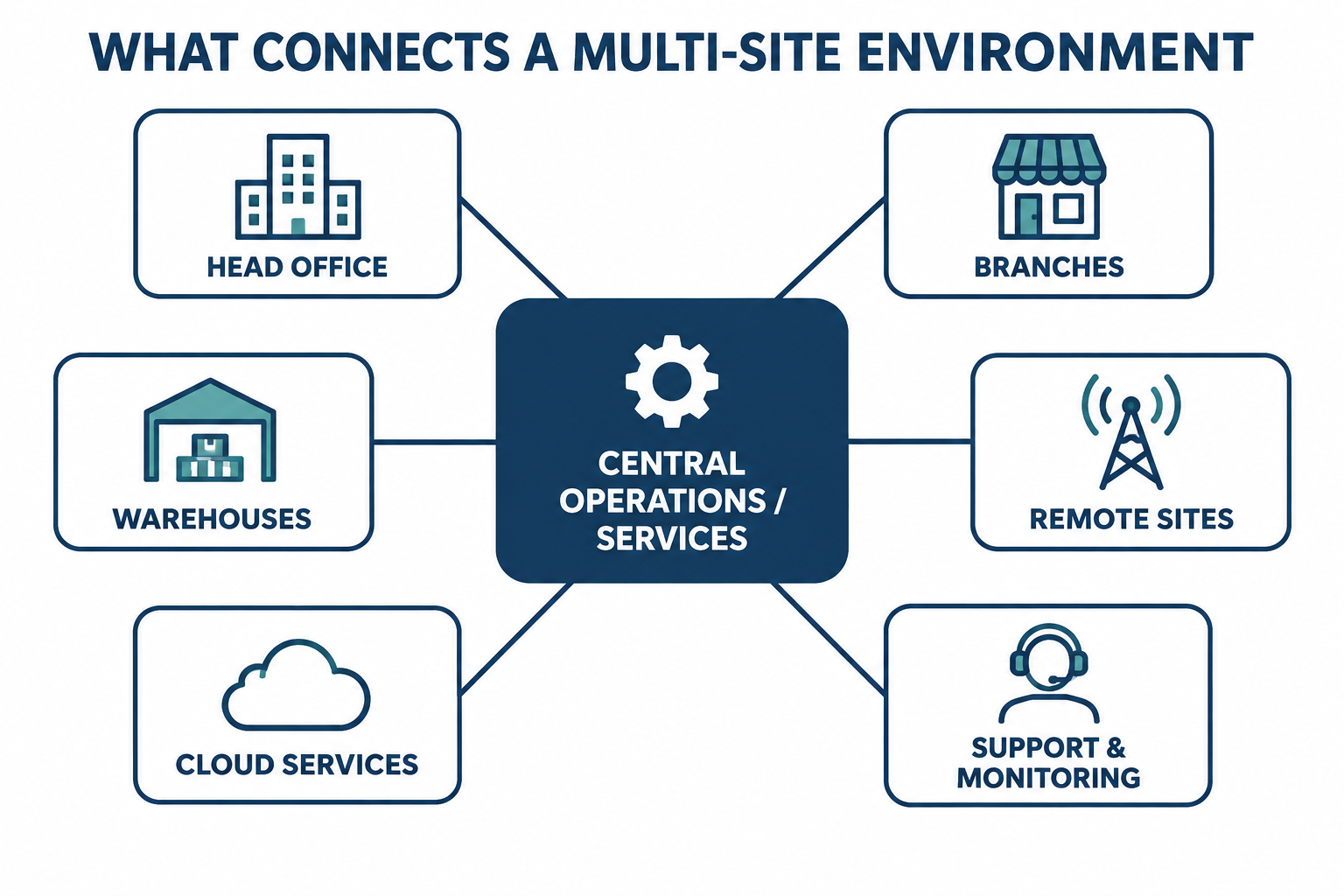
Multi-site infrastructure is easier to manage when locations are treated as part of one operational environment rather than separate technology projects.
Remote support depends on visibility
The further a site is from the people supporting it, the more valuable good monitoring and documentation become.
When something fails at a remote branch, the first challenge is often understanding what has actually happened. Is the internet service down? Has a switch failed? Has power been lost? Is a wireless access point offline, or has somebody simply disconnected it during other work?
Without visibility, every incident becomes a process of elimination carried out through phone calls.
Central management tools can reduce that uncertainty where appropriate, but they are only part of the solution. Infrastructure should also be documented well enough that support personnel know what exists at the location and how the important components connect.
Accurate records of switches, access points, fibre links, internet circuits, racks and addressing can significantly reduce the time needed to diagnose a remote problem.
Local site contacts also matter. A central support team may understand the technology but still need someone on the ground to confirm whether power is available, whether equipment has been physically moved or whether building work is taking place near a communications cabinet.
Remote support works best when technical visibility and practical site knowledge support one another.
Security controls need consistency across locations
Distributed environments can develop uneven security simply because different sites are upgraded at different times.
A head office may have well-defined network segmentation and controlled administrator access while a smaller branch continues using older configurations because it has attracted less attention.
Attackers and failures do not necessarily respect organisational priorities.
Security standards should therefore apply across the estate according to risk, even when the underlying equipment differs.
That can include consistent approaches to administrator accounts, remote access, firmware management, wireless security, network segmentation and the treatment of connected devices such as cameras and access-control equipment.
It is particularly important to understand how remote sites connect back to central systems.
Temporary remote-access arrangements have a habit of becoming permanent. A connection created to help a contractor complete commissioning can remain active long after the project ends unless responsibility for removing it is clear.
The same is true of old user accounts, unused management tools and devices installed for projects that later change scope.
Multi-site environments benefit from periodic review because small exceptions accumulate easily when responsibility is spread across many locations.
Documentation and change control prevent sites from drifting apart
A well-documented network can become poorly documented surprisingly quickly.
Someone moves a device, changes an uplink, replaces a switch or adds a new camera. The change solves an immediate problem, but the central record remains untouched.
After enough small changes, the documentation and the real environment become different systems.
This is especially common in organisations where several service providers work across different regions.
Change control does not need to mean a heavy approval process for every cable that gets moved. It means that changes which affect the infrastructure are recorded consistently enough for the organisation to know what it owns and how it is configured.
A useful record might capture what changed, when it changed, who performed the work and whether drawings or configuration documentation also need to be updated.
That discipline becomes valuable during larger upgrades. If a central project team can trust the existing records, it can plan more accurately and avoid sending teams to every location simply to rediscover the infrastructure.
Multi-site operations need a support model, not only equipment
Technology estates often become difficult to manage because procurement receives more attention than the operating model that follows deployment.
Installing equipment is only the beginning.
Someone needs to monitor it, respond to failures, manage changes, coordinate warranties, maintain spares and determine when ageing infrastructure should be replaced.
For distributed operations, escalation paths should be particularly clear. Local users need to know where to report issues. The support team needs enough information to distinguish a local problem from a wider service outage. Specialist contractors may need to be dispatched when remote troubleshooting is not enough.
Spare equipment can also be approached according to risk rather than habit.
It may make sense to keep replacements for certain common components centrally, while critical remote sites justify local spares because delivery delays would have a disproportionate operational impact.
The right model depends on the organisation, but the principle is consistent: support should be designed with the infrastructure, not added informally after deployment.
The aim is consistency without unnecessary uniformity
A multi-site organisation will almost always contain differences.
Buildings differ. User numbers differ. Operational requirements differ. Connectivity options vary by location, and older sites may take time to bring into line with newer standards.
The objective should not be to pretend those differences do not exist.
Instead, organisations benefit from establishing a common infrastructure language: agreed design principles, documentation standards, security controls, support processes and a clear view of which deviations are intentional.
That makes expansion easier.
When a new branch opens, the organisation has a starting point rather than designing everything from scratch. When an existing site is upgraded, the project team understands what standards it should move toward. When a fault occurs, support personnel can work from a familiar structure even if they have never visited the location before.
Technology across multiple sites becomes difficult when each location turns into an isolated project.
It becomes much easier to manage when every site is treated as part of one operational environment, with enough standardisation to create visibility and enough flexibility to reflect what each location actually needs.
Related services
Related insights
Why Site Readiness Matters Before ICT and Security Deployment
A technically sound CCTV, access-control or network design can still run into trouble if the site is not ready for installation. Clear access, confirmed drawings, completed power, prepared cable routes and equipment availability should be established before deployment teams are dispatched.
Structured Cabling for Modern Enterprise Environments
Enterprise networks increasingly carry far more than ordinary user traffic. CCTV, access control, wireless access points, voice systems and connected devices all depend on the same physical infrastructure. Good structured cabling is therefore less about installing cable and more about creating a reliable foundation for everything connected to it.
Enterprise Network Readiness: What to Review Before a Major Technology Upgrade
Technology upgrades can fail for reasons that have little to do with the new system itself. Ageing cabling, overloaded switches, weak wireless coverage, poor documentation and inadequate power or resilience can all become bottlenecks. A network-readiness assessment helps identify those constraints before deployment begins.